Most marketing strategies do not fail because the team lacks ideas. They fail because every new campaign adds more complexity than momentum. Budgets increase, dashboards multiply, teams move faster, but revenue does not grow at the same rate.
A scalable marketing strategy works differently. It gives your brand a repeatable way to attract the right audience, convert demand into pipeline or sales, learn from performance data, and reinvest in the channels and assets that keep improving over time.
For companies in Dubai, the UAE, and wider GCC markets, scale also means handling multilingual audiences, premium and price-sensitive buyer segments, fast-moving media costs, and strong competition from local and global brands. The goal is not to do more marketing. The goal is to build a system that can grow without breaking.
What makes a marketing strategy scalable?
A strategy scales when it can handle more budget, more customers, more markets, and more product lines without requiring the entire team to reinvent the plan every month. It is built on clear economics, consistent messaging, strong measurement, and channels with defined roles.
A fragile strategy often depends on one viral campaign, one platform, or one high-performing ad. A scalable strategy is more resilient. It combines short-term demand capture with long-term brand and content assets, then uses data to improve each cycle.
| Fragile marketing | Scalable marketing |
|---|---|
| Campaigns are planned one at a time | Campaigns follow a reusable growth system |
| Success is measured mostly by clicks or reach | Success is tied to pipeline, sales, retention, and profit |
| Messaging changes from channel to channel | Positioning stays consistent while creative adapts |
| Budget increases before learning is validated | Budget increases after unit economics are proven |
| Reporting explains what happened | Analytics guide what to do next |
Scalability is not the same as size. A small company can have a scalable strategy if it knows who it serves, why those customers buy, which channels have the best role, and what numbers must improve before spend increases.
Start with commercial outcomes, not channel ideas
Many planning sessions begin with questions like, should we run TikTok ads, invest in SEO, or launch an influencer campaign? Those questions matter, but they come too early.
A scalable marketing strategy starts with the business result. Are you trying to increase qualified leads, ecommerce revenue, app sign-ups, repeat purchases, booked consultations, or enterprise pipeline? Each outcome requires a different funnel, budget model, and measurement plan.
Work backward from the commercial target:
| Planning metric | Why it matters |
|---|---|
| Revenue target | Defines how much growth marketing must influence |
| Average order value or deal size | Shows how many customers or deals are needed |
| Gross margin | Determines how much you can afford to acquire a customer |
| Conversion rate | Reveals where the funnel needs improvement |
| Customer acquisition cost | Helps decide whether paid growth can scale profitably |
| Sales cycle length | Shows how long it may take for campaigns to produce revenue |
| Retention or repeat purchase rate | Determines whether growth compounds or constantly resets |
For example, a B2B brand targeting AED 2 million in new pipeline needs a different strategy than a direct-to-consumer brand aiming for AED 2 million in online sales. The B2B plan may depend more on LinkedIn, search, content, account-based campaigns, lead nurturing, and sales enablement. The consumer plan may lean more heavily on paid social, creators, ecommerce SEO, offers, landing pages, and lifecycle marketing.
When the commercial math is clear, every marketing decision becomes easier. You know what volume is needed, what cost per acquisition is acceptable, and which conversion points deserve the most attention.
Define the customers you can win repeatedly
Scale comes from repeatability. If your team has to chase a completely different audience every month, performance becomes unpredictable. The stronger move is to identify the customer segments where your brand has a real advantage.
An ideal customer profile should go beyond demographics. It should explain the buyer's problem, urgency, decision criteria, objections, budget reality, and preferred buying path. For a UAE business, that may include language preference, emirate or region, cultural context, payment behavior, business maturity, and whether the buyer expects local support.
Useful inputs include CRM data, sales call notes, search query reports, customer interviews, website analytics, social listening, and competitor reviews. The best insights usually come from comparing what customers say before they buy with what your data shows after they convert.
McKinsey has reported that organizations using customer behavioral insights outperform peers in sales growth and gross margin. The practical lesson is simple: scale is easier when strategy is built around real customer behavior rather than assumptions.
A scalable customer profile should answer four questions:
- Who buys fastest and stays longest?
- What trigger makes the problem urgent now?
- What proof do they need before they trust you?
- Which channels do they already use when researching solutions?
Once these answers are clear, your strategy stops treating the market as one large audience. It becomes a focused plan for winning the segments most likely to convert and grow.
Turn positioning into an offer system
A marketing strategy cannot scale if every landing page, ad, email, and sales deck explains the brand differently. Positioning gives the whole system a shared foundation.
The goal is not to write a clever slogan. The goal is to define why your brand is the right choice for a specific audience in a specific situation. This should be translated into an offer system that your team can reuse across channels.
| Message layer | What it clarifies |
|---|---|
| Category | What type of solution you provide |
| Audience | Who the offer is built for |
| Pain point | What problem or opportunity matters most |
| Promise | What outcome customers can expect |
| Proof | Why the audience should believe you |
| Call to action | What the buyer should do next |
This structure is especially important when a brand uses multiple channels. Paid search may need a direct offer. SEO content may need educational depth. Influencer campaigns may need a more human story. Lifecycle emails may need reassurance and urgency. The tone changes, but the core value proposition should remain consistent.
If your positioning is weak, scaling spend will only expose the weakness faster. If positioning is strong, every channel becomes easier to optimize because the team is amplifying a clear idea.
Assign every channel a job
Scalable marketing is not about being everywhere. It is about knowing the role each channel plays in the growth system.
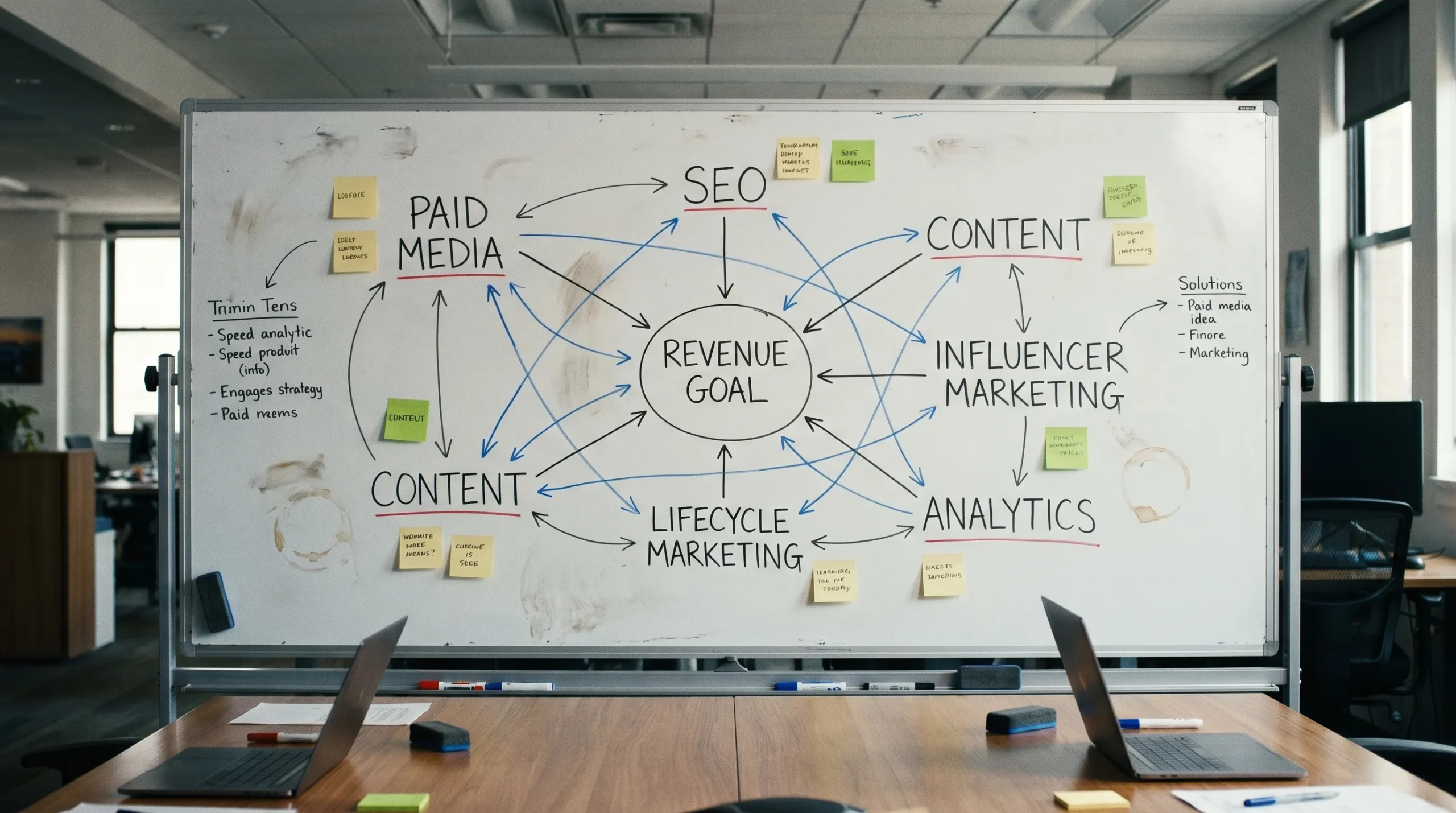
Paid media can validate messages quickly and create predictable demand capture. SEO and content can build compounding visibility around high-intent searches. Influencer marketing can create trust and social proof. Lifecycle marketing can turn leads and customers into repeat revenue. Analytics connects these activities so decisions are based on performance instead of preference.
| Channel | Best role in a scalable strategy | Common mistake |
|---|---|---|
| Paid search | Capture existing intent and test high-converting offers | Scaling keywords before landing pages convert |
| Paid social | Create demand, test creative angles, and retarget engaged audiences | Judging performance too early or only by last-click revenue |
| SEO | Build durable visibility for problems, comparisons, and solutions | Publishing content without intent or conversion paths |
| Content marketing | Educate buyers, support sales, and build authority | Measuring only traffic instead of assisted pipeline or leads |
| Influencer marketing | Borrow trust and reach from relevant creators or experts | Choosing creators based only on follower count |
| Lifecycle marketing | Nurture leads, increase retention, and reactivate audiences | Sending generic campaigns with no segmentation |
| Affiliate marketing | Extend distribution through performance-based partners | Ignoring brand fit and partner quality |
| Web and app design | Reduce friction and improve conversion | Treating design as aesthetics instead of a revenue lever |
This is where strategy becomes practical. Instead of asking which channel is best, ask which job must be done next. If demand exists but conversion is weak, the priority may be landing pages and offer testing. If people do not know the category, content and paid social may need to educate the market. If leads are coming in but not closing, lifecycle marketing and sales enablement may matter more than more traffic.
For a deeper look at building demand through useful assets, read Performance Stimuli's guide to content marketing that drives leads and long-term growth. For B2B brand building, the LinkedIn case study shows how consistent publishing can support authority, trust, and inbound intent over time.
Build the funnel before you scale traffic
More traffic does not fix a broken funnel. It usually makes the problem more expensive.
A scalable funnel maps the customer journey from first touch to revenue and beyond. It identifies what the buyer needs at each stage, which conversion action matters, and what content or experience helps the buyer move forward.
Google's research on the messy middle of purchase behavior highlights how people move between exploration and evaluation before making decisions. That is why modern funnels should not be treated as perfectly linear. Buyers may compare alternatives, read reviews, return through search, click a retargeting ad, and speak to sales before converting.
| Funnel stage | Buyer question | Marketing responsibility |
|---|---|---|
| Awareness | What is this problem and why does it matter? | Educate and create relevance |
| Consideration | Which options should I compare? | Provide proof, differentiation, and useful comparisons |
| Conversion | Why should I act now? | Reduce friction and make the next step clear |
| Retention | How do I get more value? | Improve onboarding, communication, and repeat engagement |
| Advocacy | Why should I recommend this? | Encourage reviews, referrals, and community signals |
The funnel should also account for the handoff between marketing and sales. If leads are not qualified, sales teams lose time. If follow-up is slow, paid media performance suffers. If CRM stages are unclear, reporting becomes unreliable. A scalable strategy connects every handoff before increasing volume.
Build measurement before increasing spend
If you cannot see what is working, you cannot scale with confidence. Measurement is the operating system of a scalable marketing strategy.
Start with a simple hierarchy. At the top are business outcomes such as revenue, qualified pipeline, booked calls, customer acquisition cost, and retention. In the middle are conversion metrics such as lead quality, cost per qualified lead, landing page conversion rate, and email engagement. At the bottom are diagnostic metrics such as click-through rate, cost per click, scroll depth, and creative fatigue.
Tools matter, but structure matters more. Your analytics setup should include clean UTM naming, well-defined conversion events, CRM integration, and regular data quality checks. Google's documentation on GA4 events is a useful starting point for understanding how user actions can be captured and analyzed.
| Measurement layer | What to track | Decision it supports |
|---|---|---|
| Business outcomes | Revenue, profit, pipeline, retention | Whether marketing is growing the company |
| Funnel performance | Leads, qualified leads, sales opportunities, conversion rates | Where to improve the buyer journey |
| Channel efficiency | CAC, ROAS, cost per qualified lead, assisted conversions | Where to invest or reduce budget |
| Creative learning | Hook, offer, format, audience response | Which messages deserve more spend |
| Customer quality | Repeat purchase, close rate, churn, lifetime value | Whether growth is sustainable |
Attribution should be treated as a decision aid, not absolute truth. Last-click reports often understate channels that create demand, such as content, influencers, and social. Multi-touch reporting, incrementality tests, and CRM feedback give a more balanced view.
The key is to decide in advance which metrics trigger action. A dashboard that never changes decisions is not strategy. It is decoration.
Turn campaigns into growth loops
One-off campaigns can create spikes. Growth loops create compounding momentum.
A growth loop is a repeatable cycle where one marketing action creates data, assets, audiences, or customers that make the next action stronger. This is the difference between launching ads and building a performance engine.
Examples include:
- SEO content loop: Search data reveals high-intent topics, content earns rankings, pages generate leads, sales feedback improves future content.
- Paid media learning loop: Ads test hooks and offers, winners inform landing pages, conversion data improves targeting, stronger creative unlocks more budget.
- Lifecycle loop: Leads enter segmented nurture journeys, engagement data improves messaging, better education raises close rates and retention.
- Influencer loop: Creator campaigns generate content and social proof, top assets are repurposed in paid media, performance data guides future partnerships.
- Affiliate loop: Partner activity drives qualified traffic, conversion data identifies high-quality partners, stronger partners receive better assets and incentives.
Loops are powerful because they reduce waste. Each cycle teaches the team something useful. Over time, the brand builds a library of proven messages, stronger audiences, better content, and more reliable benchmarks.
Use experiments to find repeatable wins
Scaling before testing is expensive. Testing without a decision framework is slow. The solution is a clear experimentation process.
Every experiment should define the hypothesis, audience, channel, budget, success metric, learning window, and next action. This prevents teams from declaring victory because one metric improved while the business result stayed flat.
| Experiment element | Example question |
|---|---|
| Hypothesis | If we change the offer, will qualified conversion rate improve? |
| Audience | Which segment are we testing? |
| Variable | Are we testing creative, landing page, offer, channel, or follow-up? |
| Success metric | What number must change for this to matter? |
| Learning window | How long will the test run before a decision? |
| Next action | Will we scale, iterate, pause, or archive the learning? |
A good scaling rule protects your budget. Increase spend only when the channel has enough conversion volume, acquisition costs are within target range, lead or customer quality is acceptable, creative performance is not collapsing, and the operations team can handle more demand.
This rule matters because growth can create hidden strain. If lead response time slows down, customer support quality drops, or fulfillment capacity breaks, marketing performance will eventually suffer. Scale should include the whole customer experience.
Create an operating rhythm for growth
A marketing strategy only scales if the team has a rhythm for making decisions. Without cadence, even good plans drift.
Weekly meetings should focus on active campaigns, budget shifts, creative performance, and immediate blockers. Monthly reviews should connect channel performance to pipeline, sales, retention, and customer insights. Quarterly planning should revisit positioning, market opportunities, channel mix, and larger bets.
| Cadence | Focus | Output |
|---|---|---|
| Weekly | Performance diagnostics and tactical decisions | Budget changes, creative iterations, issue fixes |
| Monthly | Funnel and revenue review | Channel priorities, conversion improvements, learning summary |
| Quarterly | Strategic direction | Market expansion, major campaigns, resource allocation |
This rhythm keeps marketing from becoming reactive. It also creates accountability. Everyone knows what is being measured, when decisions are made, and how learning turns into action.
For growing companies, this is often where an external performance marketing agency adds value. The benefit is not just campaign execution. It is the ability to connect paid media, SEO, content, analytics, lifecycle marketing, and creative testing into one operating model.
A 90-day roadmap to build a scalable marketing strategy
You do not need to rebuild everything at once. A focused 90-day plan can create the foundation for scale.
| Timeline | Focus | Key outcome |
|---|---|---|
| Days 1 to 30 | Diagnose business goals, customer segments, funnel gaps, tracking quality, and existing channel performance | A clear growth model and priority list |
| Days 31 to 60 | Launch controlled tests across priority channels, refine offers, improve landing pages, and fix measurement gaps | Early learning and validated conversion signals |
| Days 61 to 90 | Scale winning tests, build content and lifecycle assets, document playbooks, and align reporting with revenue | A repeatable system for growth decisions |
The first month should be honest. Look for the real constraint, not the most visible symptom. Sometimes the issue is traffic volume. Often it is positioning, offer clarity, lead quality, weak follow-up, or poor tracking.
The second month should create controlled momentum. Avoid launching too many disconnected initiatives. Choose the channels and conversion points most likely to prove or disprove your growth assumptions.
The third month should focus on repeatability. Document what worked, what failed, why it happened, and what the next budget increase requires. This turns early wins into a scalable playbook.
Common reasons marketing strategies stop scaling
Even strong brands hit plateaus. The most common cause is not a lack of effort, but a lack of system discipline.
Strategies often stop scaling when teams increase budget before proving unit economics, add new channels before fixing conversion paths, optimize for leads that sales cannot close, or change messaging so often that the market never understands the brand. Another common issue is over-reliance on last-click attribution, which can cause teams to cut demand-creating channels too early.
Creative fatigue is another major blocker. Audiences get used to the same angles, formats, and offers. Scalable teams treat creative as a performance variable, not a final deliverable. They continuously test hooks, proof points, landing page messages, and content formats.
Finally, retention is often ignored. If customers do not repeat, renew, refer, or expand, acquisition must work harder every quarter. A scalable marketing strategy looks beyond the first conversion and builds lifecycle communication that increases customer value over time.
Frequently Asked Questions
What is a scalable marketing strategy? A scalable marketing strategy is a growth plan that can increase revenue without adding the same level of cost, complexity, or manual effort. It uses clear positioning, reliable channels, strong measurement, and repeatable experiments.
How long does it take to build a marketing strategy that scales? Most companies can build the foundation in 60 to 90 days, but true scale depends on the length of the sales cycle, budget, market demand, data quality, and how quickly the team can test and implement improvements.
Which channels should a scalable strategy include? The best channel mix depends on your audience and business model. Many scalable strategies combine paid media for speed, SEO and content for compounding demand, lifecycle marketing for retention, and analytics to guide investment decisions.
How do I know if my marketing is ready to scale? You are closer to scale when your acquisition costs are within target, conversion rates are stable, lead or customer quality is strong, tracking is reliable, and your team can handle more demand without hurting the customer experience.
Is brand building part of performance marketing? Yes. Brand building improves trust, recall, and conversion efficiency. Performance marketing works best when short-term acquisition is supported by consistent messaging, proof, content, and customer experience.
Should a startup and an established company use the same strategy? No. A startup may focus on validating audience, offer, and channel fit. An established company may focus on improving efficiency, expanding into new segments, increasing retention, or integrating multiple channels into one growth system.
Build a marketing strategy designed for scale
A strategy that actually scales is not a bigger calendar, a larger ad budget, or a longer list of platforms. It is a connected growth system: clear commercial goals, focused customer segments, sharp positioning, defined channel roles, reliable measurement, and disciplined experimentation.
If your brand is ready to move from scattered campaigns to a data-led growth engine, Performance Stimuli can help align SEO, paid media management, influencer marketing, marketing analytics, content, lifecycle marketing, lead generation, affiliate marketing, brand identity, and web or app design around measurable growth.
Start by asking one question: if your best-performing campaign received twice the budget next month, would your strategy scale, or would it break? The answer shows exactly where to focus next.